
SCIENCE
-

Ask Ethan: How much damage could a cosmic ray do to a human?
At the upper limits of what’s energetically possible, cosmic rays still persist. What happens if a human gets hit by…
Read More » -

Dark matter’s “nightmare scenario” looks more likely than ever
Our great hope is that today’s indirect, astrophysical evidence will someday lead to successful direct detection. What if that’s… Continue…
Read More » -

What the Universe looks like: from nearby to far away
Outer space begins just over 100 kilometers up, but what we can see extends for billions of light-years. Here’s what…
Read More » -
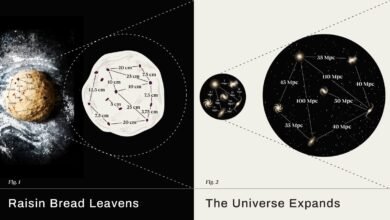
Ask Ethan: Where are all the blueshifted galaxies?
Even in an expanding Universe, we expect both redshifted and blueshifted galaxies. But nearly every one we see is redshifted.…
Read More » -
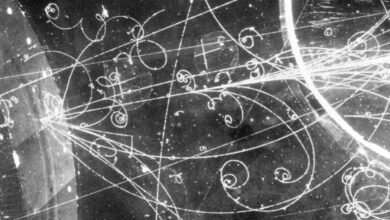
The most underappreciated achievement in theoretical physics
Many view the development of fringe, alternative theories as a useless waste of time. But when they can be tested,…
Read More » -
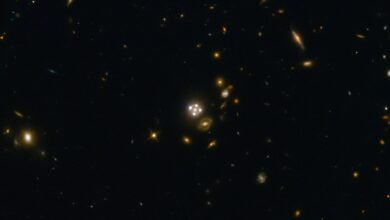
Ask Ethan: Why do gravitational lenses make crosses, not rings?
Gravitational lenses arise when foreground masses and background light sources properly align. Einstein rings are rare, but crosses abound. Continue…
Read More » -
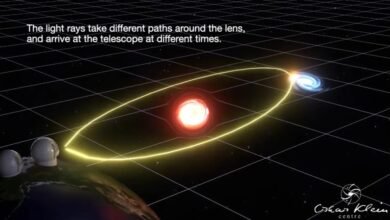
New JWST lens survey: can it save the expanding Universe?
The VENUS survey isn’t about planets at all, but about finding multiply lensed supernovae. The ambition? To save the expanding…
Read More » -
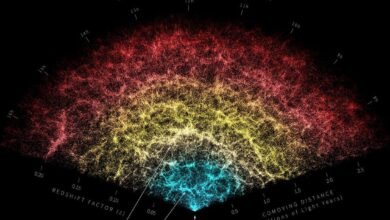
Starts With A Bang podcast #125 — Large-scale structure
The seeds of cosmic structure that were planted back during the Big Bang grew into the cosmic web we see…
Read More » -

Zeno’s Paradox resolved by physics, not by math alone
Travel half the distance to your destination, and there’s always another half to go. So how do you eventually arrive?…
Read More » -
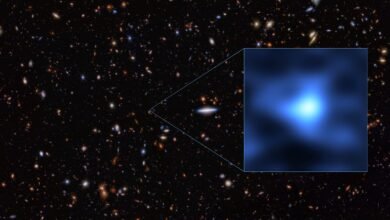
What does oxygen in JWST’s most distant galaxies really mean?
In a galaxy less than 300 million years after the Big Bang, oxygen’s presence abounds. That’s expected; its absence would…
Read More »