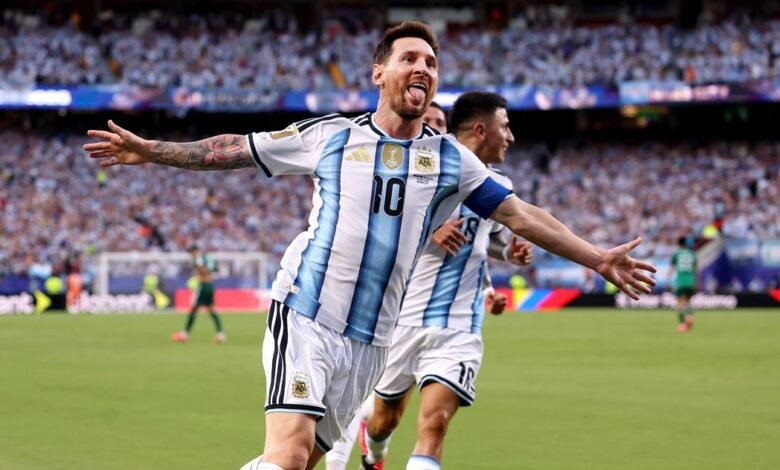

Photo: Charlotte Wilson/Getty Images
Sports are inevitably full of perceived saviors and scoundrels, but Argentina’s soccer team often seems to occupy both roles at the same time. No team blends soccer’s central duality better: the tension between flair and brutality, between honoring the game and seeing what you can get away with in order to win. Historically, Argentina veers between playing soccer at its highest level and stooping to its lowest.
Four years ago, Lionel Messi, soccer’s greatest ever player, won the World Cup with Argentina in his fifth attempt, erasing the only blemish in his incredible career with a starring role in what was called the best final of all time. This tournament feels different. Argentina is an enigma of a team centered around Messi and the religious fervor he inspires — plus, some suspect, occasional help from the officials. Suddenly, what was charming four years ago looks questionable. As they square off in the quarterfinals on Saturday against Switzerland, Argentina is, strangely enough, the closest thing this World Cup has to a villain.
They kicked off the tournament positively enough: all that title pressure was gone after 2022, the squad and coaching staff were unusually settled, and Messi was scoring as easily as ever. Their initial games resembled a greatest-hits compilation; the “Last Dance” vibes were high.
But the World Cup inevitably reveals who you are when you’re put to the test.
In the round of 16, Argentina, a heavy favorite, was down a goal to Egypt early in the second half. Egypt dispossessed Argentina deep in its own half, then beautifully dribbled, passed and slashed their way across the field, scoring a spectacular counterattacking goal, possibly the best of the tournament. Argentina was suddenly on the ropes. Then, things took a turn.
Messi had spotted a possible foul before the play began and demanded the sideline official tell the referee to review it. It seemed unwarranted — the referee had initially let play go on, and Argentina still had the entire field to stop their opponent after the foul was said to have occurred. Nevertheless, the referee acceded to Messi’s request, then disallowed Egypt’s goal. Many watching, including the announcers, were stunned. But Egypt’s outrage was just beginning. Argentina eventually roared back to tie the game (with a goal from Messi). And then in another officiating blunder, the same referee denied Egypt’s legitimate claims for a penalty kick late in the game and refused to review it. Argentina pulled off a dramatic 3-2 victory, Egypt filed a formal complaint about the refereeing shortly after, and Messi-mania lived on for another round. But at what cost? It felt like two oft-criticized entities, VAR and FIFA, had helped Argentina execute a WWE-style heel turn.
Set among the Trump Administration’s xenophobia and FIFA’s greed, the culture around the World Cup has been largely joyous, with certain teams sticking out. Norway has their good-time Viking ship row; Scotland charmed the East Coast as their fans drank bars dry; Colombia fans impressed with their zealousness. Spain and France, two of the favorites, are almost completely uncontroversial, as is Switzerland, Argentina’s opponent on Saturday. Argentina and its fans, however, are something different: they’re in the midst of a highly emotional quest that can sweep up anyone in their proximity, but they have also frequently been one of the world’s most polarizing teams — a tendency that is reasserting itself, even if FIFA is more to blame than the Argentine players themselves.
Why does Argentina inspire such emotion? Entire books and dissertations have been written about the nation’s soccer psyche, but the short of it is that its spirit is classically encompassed by the pibe archetype: a hardscrabble, picaresque kid who gets by on both skill, and cunning.
“Argentinian football is of the streets,” British soccer journalist Jonathan Wilson once explained. He wrote a book about Argentina’s soccer history called Angels with Dirty Faces. “It’s the mass games on the vacant lots of the city, where it’s all about technical skill, and there’s not a teacher there with a whistle ready to stop things if somebody steps out of line. You’ve got to look after yourself.”
It’s one thing for Tom Brady or Patrick Mahomes to inspire generations of future athletes. It’s quite another for a nation’s athletic ideal to be personified by Diego Maradona, limitlessly talented and limitlessly troubled — the perfectly rendered pibe avatar. Add to that a mid-20th century incorporation of physicality into the style of play and the intertwining of violent gangs known as “barra bravas” into the off-field culture, all taking place amid coups and assassinations, and you end up with the inveterate aesthetic of Argentina: dazzling style, ruthlessness and the occasional disregard of decorum and authority.
Maradona’s two most famous goals, both of which came in the same quarterfinal game of the 1986 World Cup, encapsulate that aesthetic. The first, a shameless handball known as The Hand of God; the second, a 60-yard solo goal in which he dribbled past five players. (Fittingly, they were both against England, inventors of the game and its rules, the ultimate representatives of the establishment.)
In the 21st century, however, two things have complicated Argentina’s narrative. The first is the country’s increasing pay-to-play youth model, which has slowly turned soccer into a middle-and upper-class game. The second is Messi. Aside from his slight build and sublime skill, he’s the anti-pibe: raised overseas, in Spain; shy; relatively guileless; trouble-free and marketable. For years, he rarely played his best in an Argentina shirt. But Messi fully won over his country in 2022, during a World Cup where Argentina’s darker side reappeared: in a bad-tempered quarter-final against the Netherlands, then again when fans and players hurled racist taunts against the mostly Black French team, their opponent in the epic final, for months afterward.
Messi and Argentina’s ascendancy raised a conundrum that has begun to boil over this tournament. El pibe is about fighting long odds and beating a corrupt system stacked against you. But what happens when the system needs pibe? FIFA clearly loves Messi. President Gianni Infantino invited Messi’s Inter Miami team to its inaugural Club World Cup tournament last year, despite Miami not qualifying, as everyone else who was there did. And Messi is the centerpiece of this year’s World Cup, scoring more goals than anyone else.
In the first three games alone, he scored six. Then Argentina was paired in the round of 32 against Cape Verde, this year’s romantic underdog. Being tasked with murdering Cinderella is not an easy assignment, and Cape Verde made it even more difficult by pushing Argentina to the brink. The South American giants were a little lucky to snatch victory late into additional extra time.
Did this great escape spook the defending champs as Egypt loomed? Perhaps more to the point: Did it spook FIFA, which is expecting to earn $8.9 billion from this tournament?
Maybe there’s a simpler explanation, an inevitable result of the Messi effect: At the Argentina-Egypt game, there was a huge disconnect between the stadium experience and the TV perspective. In the stadium, Argentina were heroes, and on TV, the villains. To witness Argentina, and Messi’s final tournament, in the flesh appears to be such an overwhelming experience that it can suspend judgment. Perhaps that applies to officials and administrators as well.
Roger Bennett, the venerable soccer personality and founder of Men in Blazers media network, was at the Argentina–Egypt game.
“For all of the charges of refereeing bias, the actual lived experience was the most profound I have had in an American stadium,” Bennett explained to me this week. “The emotion was so overwhelming, an American woman who had never been to a game before started crying because she was so moved by the near-religious ecstasy we were witnessing.” By the end of the game, “Messi walked around and sobbed inconsolably,” Bennett said. “Strangers hugged. This felt, honestly, quasi-religious. I am not a religious man, but the scenes around me were like an evangelical megachurch.”
The flip side of this ecstasy was taking place in the sewer of social media, where creepy, AI-created memes soon appeared. In one, FIFA’s Infantino feeds a baby Messi, and let’s just say they get much worse from there. Soccer, of course, is never far from corruption. FIFA has already shown it will tip the scales at this tournament, at least when Donald Trump asks. But for fans living in deeply unjust societies, the necessity to cheat at soccer in order to emerge victorious is just part of the game — an entirely different moral framing than American sports fans typically have. El pibe, in other words, is always the hero as long as he wins. But that doesn’t mean the rest of us have to cheer when it’s rewarded.
For as long as Argentina’s and Messi’s emotional World Cup lasts, their best victories should involve winning by skill. It’s hard to imagine a better storyline than Messi exiting on top by doing the things he does better than anyone — without friendly refereeing, beyond-the-pale physicality, or an adoring, aggressively shady FIFA president. However, the dark arts of soccer isn’t even the other side of the coin for Argentina; it’s all the same side, and surely they’re happy to win any way they can. They put everyone who loves the game of soccer into an almost impossible position. Root for them — or against them — at your peril.
Source link