
Photo: Andrew Caballero-Reynolds/AFP/Getty Images
When it comes to Donald Trump’s health, there’s always another mystery. The president regularly appears to nod off during meetings, and he’s frequently spotted with a makeup-covered hand bruise and other weird skin conditions. All of this is pretty typical for a person who just turned 80, but the White House rarely offers a satisfying explanation for Trump’s various physical issues, and reports on his medical exams are always light on details.
The Trump health drama du jour is particularly juicy. STAT reported on Tuesday that a lone 79-year-old man received “extraordinary” early access to retatrutide, a hotly anticipated obesity drug that may deliver weight loss on par with bariatric surgery:
But STAT has learned that Eli Lilly and the FDA have allowed one person to gain access to the drug through the FDA’s “compassionate use” program, a pathway that gives patients with serious and immediately life-threatening medical issues access to experimental treatments.
This person was a 79-year-old man at the time the request was made in April, according to three sources familiar with the matter. Those sources, who requested anonymity due to fear of reprisals, said it drew the interest of top health officials, suggesting the person receiving this drug was well connected.
This story is an absolute bombshell among Trump health conspiracy theorists, who have been insisting for months that the president is hiding something. But is there really reason to believe that Trump is the mystery patient? Here’s some evidence to consider before you hit the group chats and Reddit forums with your tinfoil-hat diagnosis.
Or at least he was before he turned 80 on June 14.
Trump’s weight, and whether he’s technically overweight or obese, has long been a topic of debate. (Yes, usually it would be weird to fixate on a political figure’s weight, but we’re talking about a looks-obsessed man who once managed to body shame an aircraft carrier.) The New York Times summarized Trump’s weight fluctuations in January 2026:
Back in 2020, during his first term in office, Mr. Trump tipped the scales at 244 pounds, a weight formally deemed obese for his 6-foot-3 frame. At the president’s last physical, in April 2025, his doctor reported that he weighed 224 pounds, putting his Body Mass Index in the overweight category, according to a Centers for Disease Control and Prevention calculator.
Trump had another physical last month, and the health summary released by his doctor said he weighs 238 pounds. That suggests he’s gained a few in the past year, but it’s really impossible to say. In the past, Team Trump has been caught claiming that the president’s height-to-weight ratio is about the same as an NFL quarterback’s, so these figures aren’t that reliable.
While STAT was unable to identify the patient, the outlet did get some information on his health profile:
A senior clinician at the National Institutes of Health named Ranganath Muniyappa requested the drug to treat the patient for refractory obesity with obstructive sleep apnea and pulmonary hypertension, a severe version of the disease. Pulmonary hypertension is high blood pressure in the lungs, which can be life-threatening.
There is no record of Trump having obstructive sleep apnea or pulmonary hypertension. But would we know if he does? Some conditions have disappeared from Trump’s medical summaries with no explanation, and experts routinely complain that the White House is omitting key information about his health.
When STAT asked White House officials if Trump is the mystery patient, they initially dodged the question:
White House spokesperson Kush Desai directed STAT’s inquiry to the Health and Human Services Department. In response to STAT’s question about whether Trump has obstructive sleep apnea and pulmonary hypertension, Desai said a White House memo detailing Trump’s most recent medical evaluation “covers this.” The memo makes no mention of obstructive sleep apnea or pulmonary hypertension.
After publication, White House spokesperson Kush Desai and the White House rapid-response team denied that Trump is taking the drug:
So if you trust everything the White House claims in rude X replies, Trump is not the mystery patient, end of story.
More than two dozen experts told STAT that the retatrutide application was very unusual, questioning why Eli Lilly would offer compassionate use to just one patient when obesity is such a widespread problem.
Who would even know to ask for an experimental drug in this manner? Well, Trump, for one. STAT noted:
It would not be unprecedented for a prominent individual to be the first person provided access to an experimental drug through the FDA’s compassionate use pathway. During the Covid-19 pandemic, Trump was notably one of the first people administered an antibody treatment from Regeneron after he contracted the virus.
Last month, President Trump made headlines for buying as much as $680,000 in Eli Lilly stock. So was our mystery patient so impressed by retatrutide that he immediately invested in the company?
It’s a creative theory, but probably not. We only learned about the stock trades made on Trump’s behalf from federal ethics disclosures released on May 14. But the purchases actually took place between January and March of this year — before the retatrutide application was submitted.
Could there still be something shady going on here? Sure. As KFF Health News reported, “the timing of Trump’s purchases coincides with several favorable government decisions benefiting the drugmaker’s GLP-1 business.” But Trump might have invested in Eli Lilly for purely financial reasons, not because he’s also a client.
STAT reported that the mystery patient “had been previously treated for a year with tirzepatide, an FDA-approved Lilly obesity drug, but experienced only moderate weight loss.” For the last year, Trump has been telling an anecdote about a friend who took the “fat drug” and didn’t lose weight:
So is the president’s “very smart,” “very rich,” and “very powerful” friend actually Trump himself? That seems unlikely, as the details in Trump’s story don’t match up (he described the friend going on regular business trips to London, and taking Ozempic, not tirzepatide).
Whether or not Trump has dabbled in obesity medication, we do know he’s a guy who’s taking massive amounts of aspirin against his doctors’ advice. It’s easy to imagine him demanding a next-generation GLP-1 because he’s convinced the regular stuff won’t work on him.
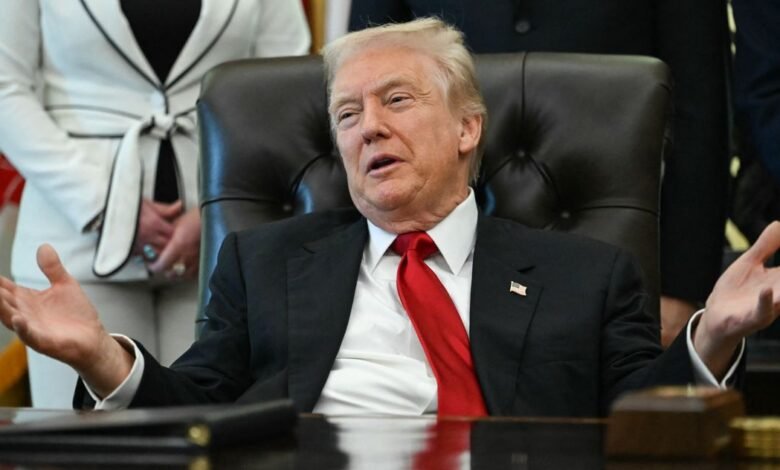
While we have no way of knowing the president’s actual weight, he looks about the same as always. If he’s been on retatrutide for months, shouldn’t we be seeing some dramatic results by now?
Maybe, maybe not. STAT says “the request was made in April,” but we don’t know the approval timeline or when the patient started taking it. It’s also an experimental therapy, so maybe it doesn’t work as well as hoped. Or perhaps the weight loss is more gradual. Trial results released by Lilly last month showed obese patients losing an average of 28 percent of their weight on retatrutide, but that was after staying on the drug for 80 weeks.
We may never know if Trump is really the mystery patient. But if he’s suddenly svelte in 18 months, we’ll have good reason to doubt that it was just the sauerkraut diet.
This piece has been updated.