(function(w,q){w[q]=w[q]||[];w[q].push([“_mgc.load”])})(window,”_mgq”);
- Russian forces have lost ground in Ukraine for a second month in a row
- Ukrainian drone strikes are killing Russian troops and weakening Russian regiments before they can even attack
- But Russia’s devastating campaign of glide bomb strikes is wreaking havoc on Ukrainian defenses, offering the Russians some hope of eventually launching their delayed spring offensive
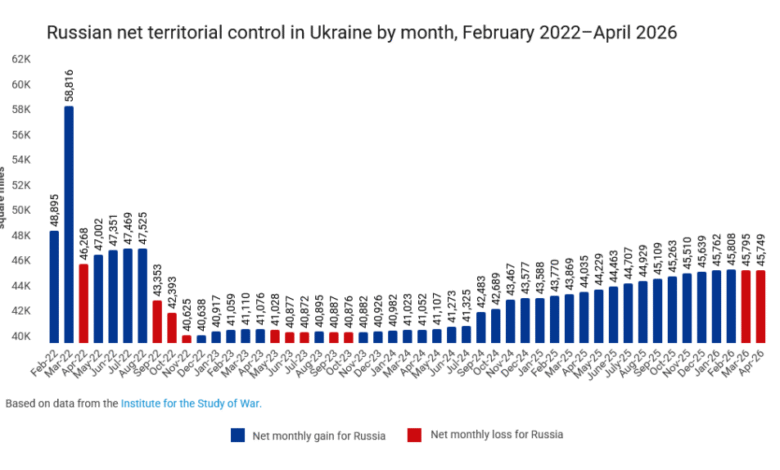
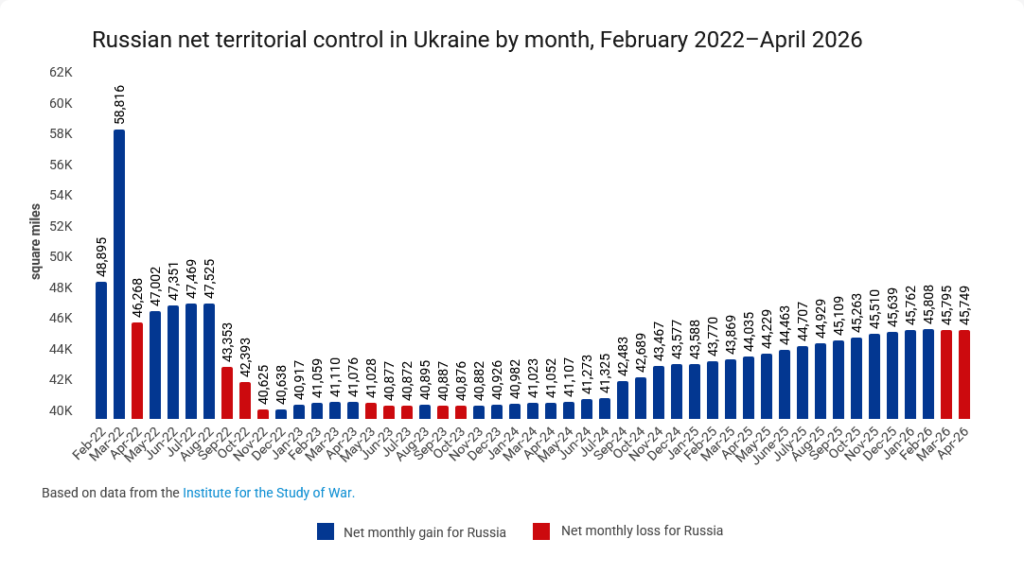
Russian troops in Ukraine fell back for the second month in a row in April, giving up an estimated 46 square kilometers of occupied territory last month after giving up 13 square kilometers in March, according to the Institute for the Study of War in Washington, D.C.
Through the spring of 2025, the Russians steadily advanced at a pace of around 40 square kilometers a month. This year’s Russian retreat means something has changed. By now it’s worth asking if Russia’s usual spring offensive has been delayed or even defeated.
One mapper and analyst senses delay, for now. But delay that could foretell a longer-term loss of momentum for the Russians. Another mapper and analyst warns against complacency on the Ukrainian side. In the air if not on the ground, the Russians are far from giving up.
“It seems the Russian offensive has been postponed, if there will be one at all,” Ukrainian mapper Vitaly wrote. According to Vitaly, the Russians’ main problem all along the 1,200-km front line is “manpower supply.”
Yes, the Russian force in Ukraine still numbers more than 700,000 troops, the same overall strength as last year—and enough to lend Russian regiments a significant manpower advantage in the most important sectors. And yes, the Kremlin is still recruiting more than 20,000 fresh troops every month through generous, but potentially unsustainable, cash bonuses.
“Just reaching the front line has become very risky”: Ukraine’s AI drones are hunting Russia’s supply vans
But escalating Ukrainian drone strikes are killing at least as many Russians as the Kremlin recruits every month, intensifying the strain on an occupying force that has been struggling to mass enough troops in the right sectors to sustain an offensive despite heavy losses.
Massing troops quickly and replacing combat losses with equal speed requires the Russians to maintain a strategic reserve of around 20,000 troops just behind the front line. The only alternative is to mass troops for an offensive in one area by pulling troops from another area, but that kind of trade risks weakening Russian positions and inviting local Ukrainian counterattacks—a dynamic we observed earlier this year as Ukrainian troops gained ground the southeast around the town of Huliaipole after Russian troops shifted north to press their offensive through the twin cities of Pokrovsk and Myrnohrad.
Russian commanders relearned the hard way in the southeast that a strategic reserve is critical. But they’ve struggled to generate enough fresh troops, month after month, to build up and maintain that reserve.
The main ukrainian
challenge for the next few months is to counter the massive air guided bombs (KAB) campaign.
On the hottest area of the frontline (Hulialpole, Dobropilla and Sloviansk), Russia is constantly hitting everything with KABs. In total, I mapped 6 600 impacts for… pic.twitter.com/nWyMbnXHOI
— Clément Molin (@clement_molin) May 10, 2026
Manpower problem
The Russians’ current manpower generation problem began last year. “The Russian military failed to achieve its goals in 2025 due to the heavy [losses] sustained during offensive operations,” Ukrainian-American analysis team Two Marines explained.
“If the current recruitment trend continues until the end of the year, the Russian army will only fulfill its recruitment plan by 80-85%,” Two Marines added. “Even for Russia’s Unmanned Systems Forces, there is a catastrophic shortage of recruits thus far. After the first four months of the year, Russia has only met 16% of its recruitment quota for the year.”
It certainly doesn’t help that Ukraine has significantly expanded its campaign of drone strikes across the Russian logistical zone, which extends around 200 km from the front line. Striking depots, trains and trucks at a pace of hundreds per month, Ukrainian drone units are weakening Russian regiments before they can even launch an assault. “Supplies are attacked in production and transit before they reach the front,” Ukrainian analysis group Tochnyi observed.
The intensifying pressure from Ukrainian drones certainly bodes ill for Russia’s much-delayed annual offensive. But the Russians aren’t exactly idle in the air. If there’s a case to be made that a Russian offensive is still in the works, it’s in the pattern of glide-bomb strikes on Ukrainian defenses.
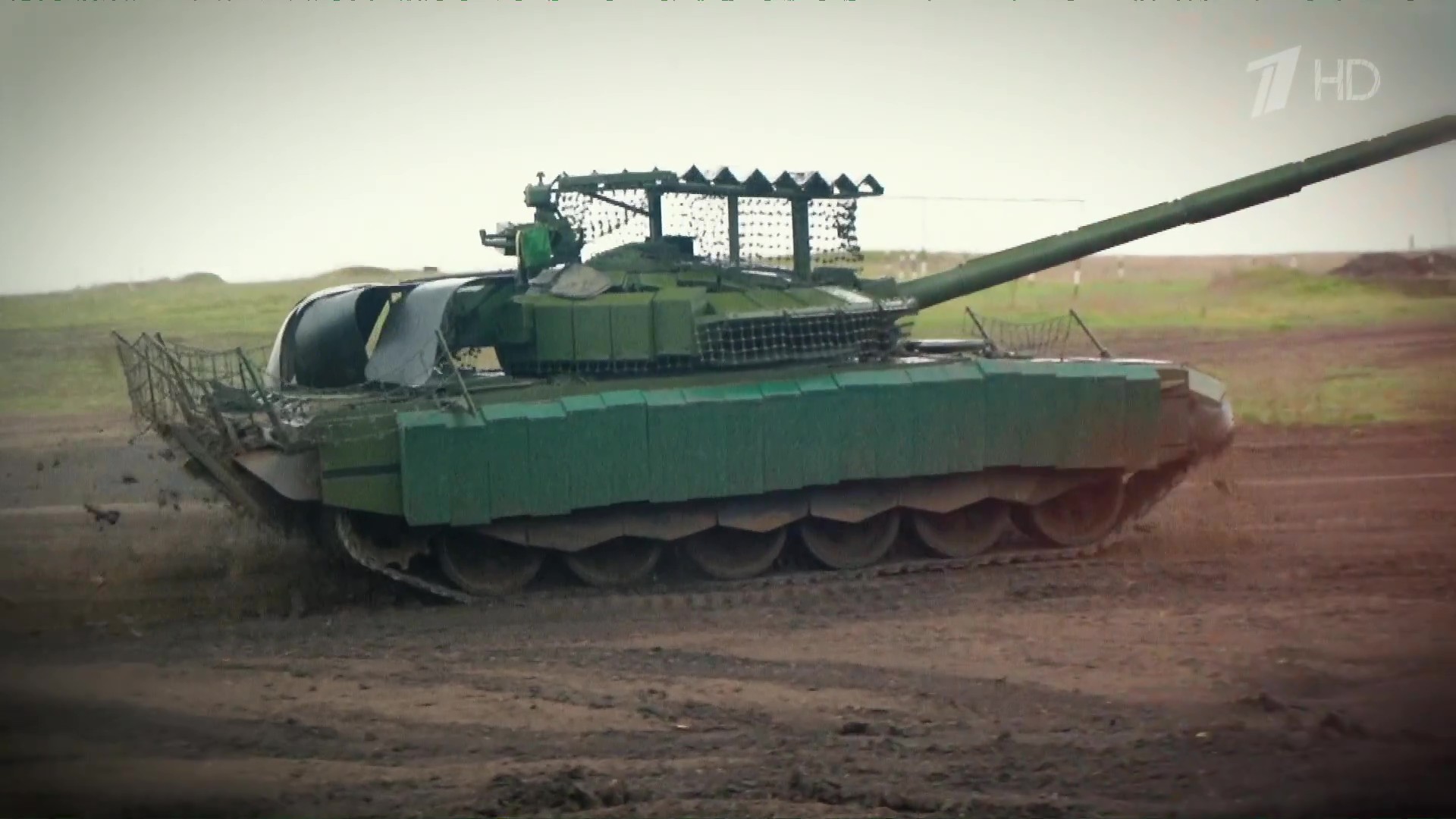
Russia’s T-72AM is a very old tank with a fresh coat of paint. Expect it to stay parked like other tanks.
Ukraine might have the drone edge. But Russia has the edge in manned warplanes lobbing precision glide bombs from tens of kilometers behind the front line. The KAB bombs wreck Ukrainian fortifications, kill and maim Ukrainian troops and complicate Ukraine’s own front-line logistics.
On the “hottest areas” of the front line around Hulialpole in the southeast, Dobropillia north of Pokrovsk in the east as well as Sloviansk in the east, “Russia is constantly hitting everything with KABs,” French mapper Clément Molin noted. Molin claimed he identified 6,600 KAB impacts along just 150 km of the front in just the last three months. And there are probably many thousands of additional impacts Molin conceded he couldn’t pinpoint.
The bomb blasts threaten to weaken the Ukrainian defense even more than drone strikes weaken the Russian offense, potentially allowing a belated Russian offensive to finally kick off. The “challenge for the next few months is to counter the massive … KAB campaign,” Molin stressed.
But with too few long-range surface-to-air missile batteries and too few manned fighters with long-range air-to-air missiles, Ukraine has few options for intercepting the KAB bombers before they release their deadly munitions.
So in a sense, it’s a race. Can Ukraine drone Russian forces into submission before Russia bombs Ukrainian forces into submission?
(function(w,q){w[q]=w[q]||[];w[q].push([“_mgc.load”])})(window,”_mgq”);
Source link