Ukraine’s air defense missiles didn’t match its launchers. So it built a system that doesn’t care.

(function(w,q){w[q]=w[q]||[];w[q].push([“_mgc.load”])})(window,”_mgq”);
- Ukraine has a lot of air defense equipment, but it doesn’t always match
- The new Shershen surface-to-air missile system helps solve that problem
- Shershen is compatible with different radars and missiles, some of which are make in Ukraine
Ukraine has a substantial number of surface-to-air missiles of different types. Ukraine also has significant quantities of launchers and radars for the missiles. One of Ukraine’s main air defense problems is that the missiles, launchers, and radars don’t necessarily match. So many missiles, launchers, and radars go unused.
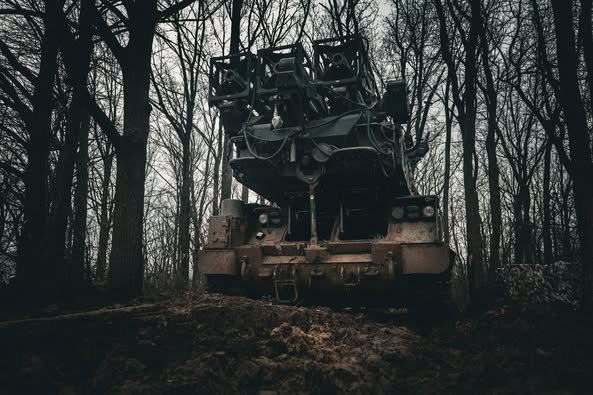
That’s why the new Shershen air defense system is such a big deal. The system, under development by the National Association of Defense Industry of Ukraine, is compatible with—so far—five different missiles, according to Militarnyi. The missiles include Soviet, Ukrainian, and Western types.
If Shershen works as designed, Ukraine could turn its stockpiles of orphaned missiles and radars into functioning air defense batteries—without waiting for Western deliveries that often arrive months late.
The system “eliminates dependence on a single supplier,” NAUDI director Serhiy Honcharov told Militarnyi.
NAUDI showed off a scale model of the Shershen at a recent trade show in Saudi Arabia. The model hints at the system’s capabilities.
The Ukrainian Shershen multi-caliber surface-to-air missile system was presented at the World Defense Show 2026, an exhibition taking place in Riyadh, Saudi Arabia.https://t.co/9lNpIuEivU
— Militarnyi (@militarnyi) February 12, 2026
For starters, it appears to include launchers for both short-range and medium-range missiles, meaning it could defend against manned aircraft, drones, and cruise missiles. Basically, all but the most kinetic Russian munitions, such as heavy ballistic missiles. For those targets, Ukraine would still rely on American-made Patriot batteries and European SAMP/T batteries.
The model on display in Saudi Arabia is fitted with what appear to be either German IRIS-T or British ASRAAM short-range infrared-guided missiles. More interestingly, the medium-range missiles in the Shershen display in Saudi Arabia are R-27s.
Normally, an air-to-air missile with either radar or infrared guidance and a range of up to 100 km, the R-27 is one of the few medium-range air defense missiles that Ukrainian industry can produce on its own.
Not coincidentally, the radar in the Shershen display seems to be a version of the made-in-Ukraine Radionix Esmeralda—normally a fighter radar for types such as the Sukhoi Su-27 and Mikoyan MiG-29. The Su-27 and MiG-29, both of which the Ukrainian air force flies in large numbers, routinely carry R-27s while patrolling for Russian fighters, drones, and cruise missiles.
Ukraine’s F-16s just shot down 34 of 35 Russian cruise missiles—and new tech may be why
Different sensors
To be clear, Shershen is compatible with other radars, including foreign models. But with a radar and a medium-range missile that are both made in Ukraine, Shershen could help preserve Ukraine’s air defense autonomy. Kyiv wouldn’t need to beg allies for missiles, launchers, and radars in order to defend itself from Russian attack.
Shershen is the natural extension of the Ukrainian “FrankenSAM” concept, which pairs available missiles, launchers and radars via various hardware and software “bridges” that help the mismatched components work together.
There are many FrankenSAMs in Ukrainian service, but each required specific engineering in order to mate disparate radar and launchers with, usually, one or two missile types. Shershen is more of a universal system that can readily accommodate a much wider array of radars, launchers, and missiles.
Yes, NAUDI claimed Shershen is compatible with five different missiles. But five is the floor, not the ceiling. “Why five?” Honcharov asked. “Because five were simply fired. If other types are needed for implementation, the work will be carried out to adapt them, and they can also be used with this system.”
That’s one way for Ukraine to ensure it always has some way of shooting down most Russian drones and missiles.
Russian air defenses are working better. That’s bad news for Ukraine’s drone strikes.
(function(w,q){w[q]=w[q]||[];w[q].push([“_mgc.load”])})(window,”_mgq”);
Source link