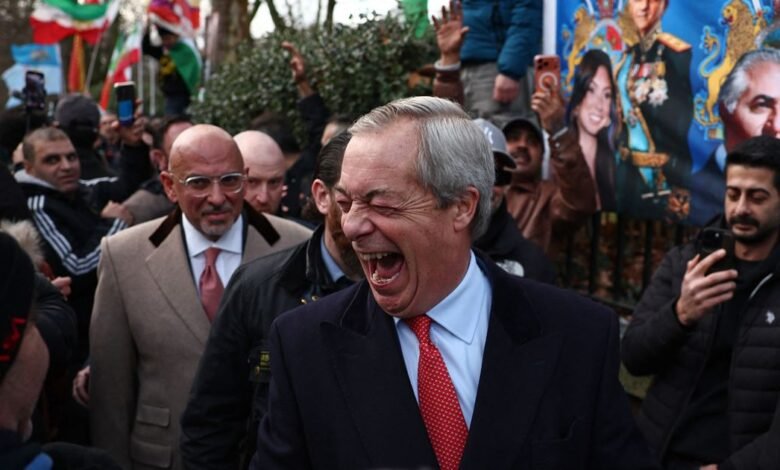

Who needs a right-wing minor-party demagogue like Nigel Farage when you have Donald Trump?
Photo: Henry Nicholls/AFP/Getty Images
If you aren’t too distracted by the unprecedented events in America’s political system recently, you might have noticed that even more shocking developments have overtaken established and once-indomitable political institutions in Europe. These include the stunning, real-time apparent collapse of the two major parties in Great Britain.
Politico’s Jamie Dettmer observes it like this:
They seem like punch-drunk prizefighters struggling to catch their breath as they slog it out. Is the party over for Britain’s storied heritage parties?
Neither the Conservatives nor their traditional Labour rival have proven strikingly fit for purpose for some time. Their combined share of the vote in recent elections has been falling and the tribal loyalties they could always rely on in the past are eroding. Increasingly the public impression is that neither has the ability to tackle the country’s huge post-Brexit problems.
The Conservatives (a.k.a. Tories), a center-right party from the 19th century that gave the U.K. Disraeli, Churchill, and Thatcher, suffered the worst electoral fiasco in British history in 2024:
They lost almost 70 percent of the 362 seats won just five years earlier. And equally alarming for party bosses, they attracted their lowest share of the vote ever in their modern history — a remarkable humbling for a party often cited as the most successful in the democratic world.
Meanwhile, the left-leaning Labour Party has rapidly lost popularity since its massive electoral win in 2024.
With the two major parties in freefall, the ascendant entity is U.K. Reform, formerly the Brexit Party. Until very recently, Reform was a pariah party widely considered to be a xenophobic gang of demagogues. But it has not only won over the Tory rank and file, it has also attracted a growing number of high-level Conservative converts — former Tory members of Parliament and government officials who have switched their affiliation to Reform. This upstart, right-populist party generally comes out on top in U.K. polling these days.
In general, the two-party system in Britain as we’ve known it seems to be in danger of collapsing, Dettmer suggests:
Scottish and Welsh nationalists have chewed away at the mainstream parties. So, too, have the revived Liberal Democrats — had they attracted two or three percent more of the overall vote 16 months ago, they might have won more seats than the Tories, becoming the main official opposition party. And now the Tories have a genuine competitor on the right.
For many years, Britain’s first-past-the-post election system (like ours) was considered an unassailable barrier to minor parties, but it doesn’t appear that way right now.
This phenomenon is not limited to Britain — across Europe, many other center-left and center-right parties are seemingly being marginalized by new populist parties. In Germany, the far-right AfD party — endorsed by Elon Musk in late 2024 and defended by J.D. Vance in early 2025 — is threatening the power of the conventionally conservative Christian Democratic Union, the party of Angela Merkel and many other German leaders. At the same time, the center-left Social Democrats, an electoral powerhouse dating back to the late 19th century, is losing vote-share to the recently created left-populist BSW party. In France, fragmentation of past political allegiances has become the rule, along with predictable instability. But there, too, a far-right party (if an older, better-established one), Marine Le Pen’s National Rally, has become the largest political force in the country.
There is no single reason for these destabilizing political trends, but it’s clear that ambivalence about economic globalization, heavy levels of refugee migration, and the dislocations created by the COVID pandemic have all contributed to the struggles of the old centrist parties and the rise of more politically extreme competitors.
Of course, this isn’t limited to Europe — similar dynamics have roiled American politics. So it’s worth asking: Can the major-party meltdown spread to the United States?
Certainly there are pervasive signs of popular disgruntlement with both Republicans and Democrats. Gallup has been tracking self-identified party affiliation since 2001, when Americans were almost evenly divided into Democrats, Republicans, and independents. As of 2025, 45 percent self-identified as independents, an all-time high, while 27 percent identified with each of the major parties. But in contrast to Europe, none of this disaffection has fed the growth of minor parties. Indeed, in both 2020 and 2024, the major-party share of the presidential vote rose to 98.1 percent, as compared to 94.3 percent in 2016 (and as low as 81 percent in 1992). Nor have any of the periodic efforts to organize a new “centrist” third-party borne any fruit, despite constant complaints about partisan and ideological polarization. Yes, America’s own first-past-the-post system has made it hard to organize, fund, and gain ballot access for nonmajor parties. The major parties have fought like hell to maintain their duopoly.
But something else is clearly going on. And the most obvious thing when you compare the United States to Europe is that the “populist” movements that have upended the centrist parties across the pond have gravitated here toward one of the major parties, the GOP. Indeed, instead of undermining the two-party system, the enemies of globalization, refugee migration, and pandemic-driven anti-elitism have reinforced it as they took control of the Republican Party via the MAGA movement of Donald Trump.
There are, unsurprisingly, distinctly American mutations of right-wing populism in the MAGA takeover of the GOP. There’s the very un-European religiosity of both pre-Trump and post-Trump grassroots conservatives, compounded by an anti-government ethos that helped fuse the interests of populists and economic elites. Trump’s own cult of personality helped make the transition from the old to the new system relatively smooth not only in his party but among Democrats — where ideological differences were generally subsumed in a common response of horror at the changes in the GOP.
But overall what killed off much of the old pre-Trump Republican Party was the dynamic that accompanied its birth back in the 1850s: the rapid replacement of one of the two major parties by a new and different electoral coalition. America didn’t need a Reform U.K. or an AfD or a National Rally party to represent a radical new movement of cultural, economic, and social reaction. It had Trump’s GOP.
Source link