
Photo: Cooper Neill/Getty Images
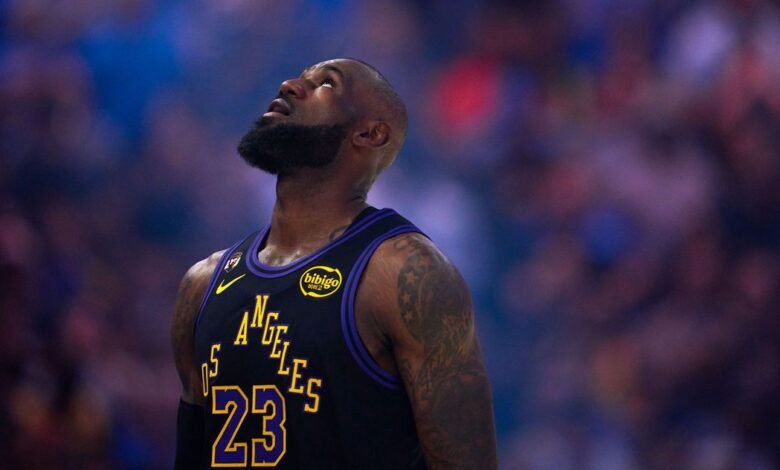
“Staying at the fucking Hyatt at 41 years old?” LeBron James, the Los Angeles Lakers star and one of the greatest NBA players of all time, told a group of YouTube golf influencers earlier this month. “You think I wanna do that shit? Being in Memphis on a fucking random-ass Thursday? I’m not the first guy to even talk about it in the NBA. We’re all like, ‘You guys have to move. Just go over to Nashville.’”
It’s true, in part. Memphis has gotten a bum rap from hoops stars of late. In February, Anthony Edwards complained about a hotel with “stains and shit” on the beds. Draymond Green said he once had to leave a hotel because the “sprinklers just went off for no reason.” But James went beyond a critique of amenities. He was calling for the NBA to leave a city.
Athletes say and do a lot of things that cause people to yell and fight. But the controversy around James’s comments about Memphis has broken beyond the confines of sports talk-show banter. TV news reporters camped out outside the Grizzlies arena and invited exiting fans to defend their city on-camera. Stephen A. Smith — not exactly a paragon of righteousness — ranted on his podcast that James had gone too far. The Commercial Appeal, Memphis’s daily newspaper, is still publishing op-eds about James’s remarks, two weeks later, on the eve of the NBA playoffs.
There are logistical reasons for this long half-life. The Grizzlies planned to renew their lease to play at FedExForum last summer, but that didn’t happen, and while stakeholders remain bullish, renegotiations are ongoing. The franchise has already relocated once, from Vancouver. And with talk of the league expanding to new markets — like Las Vegas and Seattle (which has already lost an NBA team) — player and owner concerns about disorder in Memphis loom large.
But beyond these, and the offense taken by Memphians, James’s words reflect a broader pivot. Pro athletes have retreated from politics. At the height of the Black Lives Matter movement, the economic woes of a Black city might have inspired lamentations from players or, better yet, calls for deeper investment. Today, it is easier to just leave Memphis behind.
Such is the ethos that governs our current political culture. Wealth is being redistributed upward at a dizzying clip, and social mores have retrenched such that confronting inequality is not just passé but subject to punishment. Gone is the pretense that “shithole” areas — countries, cities — deserve more than their plight. Just fix the Grizzlies by sending them to a white place.
The admonition to “shut up and dribble,” famously proffered by Fox News host Laura Ingraham, was once seen as a challenge to athletes like James — a way to prove they weren’t afraid to engage in politics. Today, an explosion of player-hosted podcasts mean that pro players are talking more, and to more people, than ever before — only to apparently have nothing to say about mass deportations, or our national turn toward autocracy, or war. Data suggests that NBA players are among the most left-leaning athletes in men’s professional sports. Yet American culture has turned so sharply rightward that it seems to be no longer worth it for them to say so.
James would admit to no such pivot. “Did I say, ‘I don’t like Black people’?” he shot back last week when reporters pushed him about unfavorably comparing Memphis, which is 63 percent Black, to Nashville, which is 55 percent white. “I’m 41 years old. There’s two cities I do not like playing in right now. That’s Milwaukee, and that’s Memphis. What is the problem with that?”
Framed this way, James was merely expressing an unobjectionable personal preference brought on by aging. He’s the oldest active player in the league and the longest-tenured player in NBA history. He’s playing on a team with his oldest son and thinking about retiring. Surely, he is entitled to his comforts. “I don’t like going home either,” James added, referring to his birthplace of Akron, Ohio. “And I’m from there!”
What James is really saying — with his pat dismissal of cities that are still navigating the fallout from deindustrialization — is that there is no good way to be a rich person in Memphis. (Or Milwaukee. Or Akron.) Sure, you can visit with money, but your options to capitalize are nil. And, absent the perks to which fabulously rich athletes like James are accustomed, what is there to like?
His invocation of Akron is especially revealing. This is a city where he has expended significant philanthropic capital. Through his foundation, James funds a specialized public school, a sprawling community center, and a full-tuition scholarship program at the local university. “There’s nobody that cares about their community the way I do,” he has said. And yet, if we take James at his word, none of the millions of dollars he has spent in Akron has turned it into a place he wants to go. This is one limit of premising social transformation on the charity of a native son who made good. Inequality endures.
Maybe transformation is not his goal. Maybe he never really had a cogent political analysis of social problems. But, for a brief period in the summer of 2020, if you squinted, it sort of seemed like something was there. James was at the vanguard of a historic wildcat strike that threatened to end the NBA playoffs. Players quarantined in Orlando’s COVID “bubble” refused to play unless their demands were met — including, on the vaguer end, more league investment in economic and educational development in Black communities and, more pointedly, pressure on lawmakers to reform the police.
It was a moment of great optimism and vitality. And it was smothered in part by ex-president Barack Obama, who counseled players to stop striking and start playing again. Teams offered up their arenas as polling sites and called it a day.
It’s still hard to envision the LeBron James of that summer scooting around a golf course disparaging the city where Martin Luther King Jr. was assassinated to entertain his white friends. Then again, he has evinced the same blithe ignorance elsewhere. Reporters at February’s All-Star Game asked him if he had a message for his fans in Israel. “I’ve never been over there,” James said, “but I’ve heard nothing but great things.” (Israel was, at that point, two years into its genocidal evisceration of Gaza.)
Maybe it’s naïve to expect more from NBA players. But it’s hard to escape a sense that the cynicism that eclipsed the optimism of 2020 is afflicting them, too. There’s a deeper funk — a feeling that the league is smaller, less important. This season kicked off with several arrests of ex-players alleged to have rigged games to gamble. Angst over “tanking” — losing on purpose to win better draft picks — dominated the remainder and amplified calls for rule changes. The playoffs start this weekend, and the MVP favorite is looked at askance by many for contorting his body unnaturally to draw fouls, a style of basketball considered not “ethical.” There is broad sentiment that success in today’s league is ill-gotten. Fans claim to hate watching.
Every major sports league goes through crises of confidence. The NFL did with CTE and bounced back. MLB did with steroids and now seems ascendant. Each managed to recuperate by implementing rules that, at least superficially, aimed to address its most glaring problems.
Yet there’s something more profoundly amiss with the NBA. Its doldrums may not be tied directly to the fall of Black Lives Matter. But they do seem to be wrapped up in a knottier string of crises ensnaring Black America. The NBA is the Blackest major men’s sports league, and its players are some of the richest and most famous Black people in the U.S. The summer of 2020 found many of them anguishing over their obligations to the Black disadvantaged. Then things started to change. A wave of backlash against DEI and “wokeness” sought to recast those disadvantages in iron. Many of the same players now seem to have settled for fulfilling their obligations to themselves. They got a taste of what it meant to stick their necks out for a cause. They decided — as many Americans have in the last six years — that it wasn’t worth the trouble.